🍽️ Oktoberfest
Oktoberfest is the regional form of Oktoberfest in Germany · Bavaria, centered on local food stalls, tastings, cooking demonstrations, community tables.

- local food stalls
- tastings
- cooking demonstrations
- community tables
- regional specialties
- desserts
- street food
- street music
- community stage
Map-ready facts
This guide turns the Bavaria, Germany local version into a map-ready entry while keeping sources, calendar context, and cultural meaning visible.
- Source-backed guide: City of Munich, Encyclopaedia Britannica
- Festival core: Oktoberfest
- Cultural meaning: Oktoberfest matters because it turns harvest gratitude, seasonal abundance, and community gathering into a visible cultural system of time, place, family, and public ritual.
Continue in the 3D map
Open the map focused on the Bavaria festival card, with country, region, and festival context preserved.
Continue in the 3D mapVisual journey
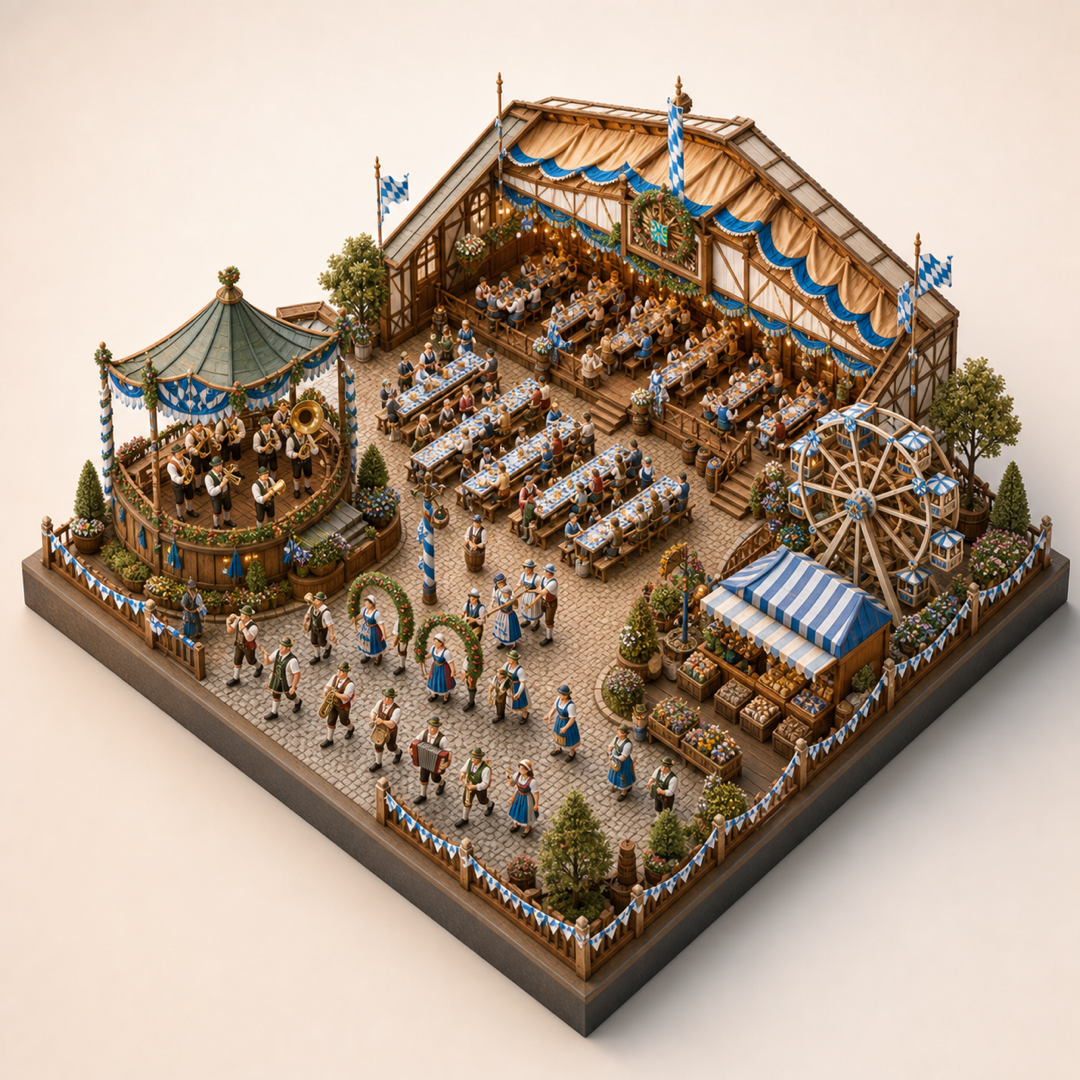
AI-generated immersive miniature model for MapDepth; not a documentary photograph.
- Community feast table: Long tables and tableware compress communal celebration into the central scene.
- Festival brass music: The brass platform makes the scene read as music as well as feasting.
- Beer tent interior: The tent structure, wood beams, and warm lights point to the Munich-style festival interior.
- Bavarian costume parade: The costume line crossing the foreground makes regional identity visible as a route.
- Fairground market edge: Small rides and market stalls complete the festival beyond the tent.
A day at Oktoberfest
In October 1810 Munich celebrated a royal wedding on a meadow outside town. More than two centuries later, the Theresienwiese is still where Oktoberfest happens.
- Opening Saturday, 10:35 · Sendlinger Tor → Theresienwiese — The landlords march in: At 10:35 on opening day the tent landlords and breweries set off from Josephspitalstraße behind Sendlinger Tor, via Sonnenstraße and Bavariaring onto the meadow: about 1,000 people.
- Opening Saturday, 12:00 · Schottenhamel tent — “O'zapft is!”: At noon the mayor taps the first keg in the Schottenhamel tent and calls “O'zapft is!” (it's tapped!). Until then, everyone in the tents waits.
- Weekend afternoon · Long tables in the big tents — The “full” signs go up: Big tents open at 10:00 on weekdays and 9:00 on weekends and holidays. On weekends and October 3 they can close by lunchtime with a “temporarily closed due to overcrowding” sign; reservation holders use side or rear doors.
- Opening Sunday, 10:00 · Through Munich to the meadow — Costume and riflemen's parade: On the second morning at 10:00, the traditional costume and riflemen's parade sets off, following on from the opening-day march.
- Every night, 22:30 · The bandstand — The last song: Bands in the big tents play from 11:00 on weekdays and 10:00 on weekends until 22:30, when beer service stops too; tents close at 23:30.
Five senses
- Hear: Live bands in the tents from morning until 22:30.
- Taste: On opening day no beer is served until the first keg is tapped at noon.
- See: The Sunday-morning costume and riflemen's parade.
- Feel: The weekend lunchtime sign at the tent door: “Wegen Überfüllung vorübergehend geschlossen”.
Times follow the official 2027 programme (Sep 18–Oct 3).
Traditions and customs
- local food stalls
- tastings
- cooking demonstrations
- community tables
Food and symbols
- regional specialties
- desserts
- street food
- 餐桌
- 地方食材
When it is celebrated
Oktoberfest timing: Usually opens in mid-to-late September and runs to around the first Sunday of October. It usually falls in September or October.
Oktoberfest
Oktoberfest matters because it turns harvest gratitude, seasonal abundance, and community gathering into a visible cultural system of time, place, family, and public ritual.
Oktoberfest details
- Celebrates: The public celebration after the 1810 wedding of Bavarian Crown Prince Ludwig and Princess Therese, now expressed through Munich beer, Bavarian folk culture, and fairground traditions.
- Local roots: It began in October 1810 as a Munich royal wedding celebration, continued on the Theresienwiese, and gradually developed beer tents, rides, and folk parades.
- Local history: Oktoberfest evolved from horse races and a public wedding celebration into a large folk festival. Today it centers on the mayor's keg tapping, beer tents, traditional costume parades, music, rides, and Bavarian food.
- Cultural meaning: This local version fuses royal wedding memory, urban fair culture, and Bavarian identity into Munich's most internationally recognized public festival.
Signature practices
- mayoral keg tapping
- beer tent gatherings
- traditional costume parade
- Bavarian brass music
- fairground rides and folk food
Customs
- local food stalls
- tastings
- cooking demonstrations
- community tables
Food
- regional specialties
- desserts
- street food
Music / Dance
- street music
- community stage
Symbols
- 餐桌
- 地方食材
FAQ
What is Oktoberfest?
Oktoberfest is the local form of Oktoberfest in Germany · Bavaria, with customs such as local food stalls, tastings, cooking demonstrations, community tables.
When is Oktoberfest celebrated?
Oktoberfest timing: Usually opens in mid-to-late September and runs to around the first Sunday of October. It usually falls in September or October.
What traditions are associated with Oktoberfest?
Common traditions include local food stalls, tastings, cooking demonstrations, community tables, regional specialties, desserts.
Sources
Editorial sources support the festival background, local customs, and cultural notes on this guide.
- Oktoberfest in Munich: Program, Tents, Map and more · City of Munich
- Oktoberfest · Encyclopaedia Britannica
- Parade of the Oktoberfest landlords and breweries · oktoberfest.de (City of Munich)
- Beer tent opening times · oktoberfest.de (City of Munich)
Image credits
Image licensing and credit details match the visible image used on this page.
Photo: Martin Falbisoner · CC BY-SA 4.0 · license: CC BY-SA 4.0 · source page
Continue in the 3D map
Open the map focused on the Bavaria festival card, with country, region, and festival context preserved.
Continue in the 3D map